
Blog
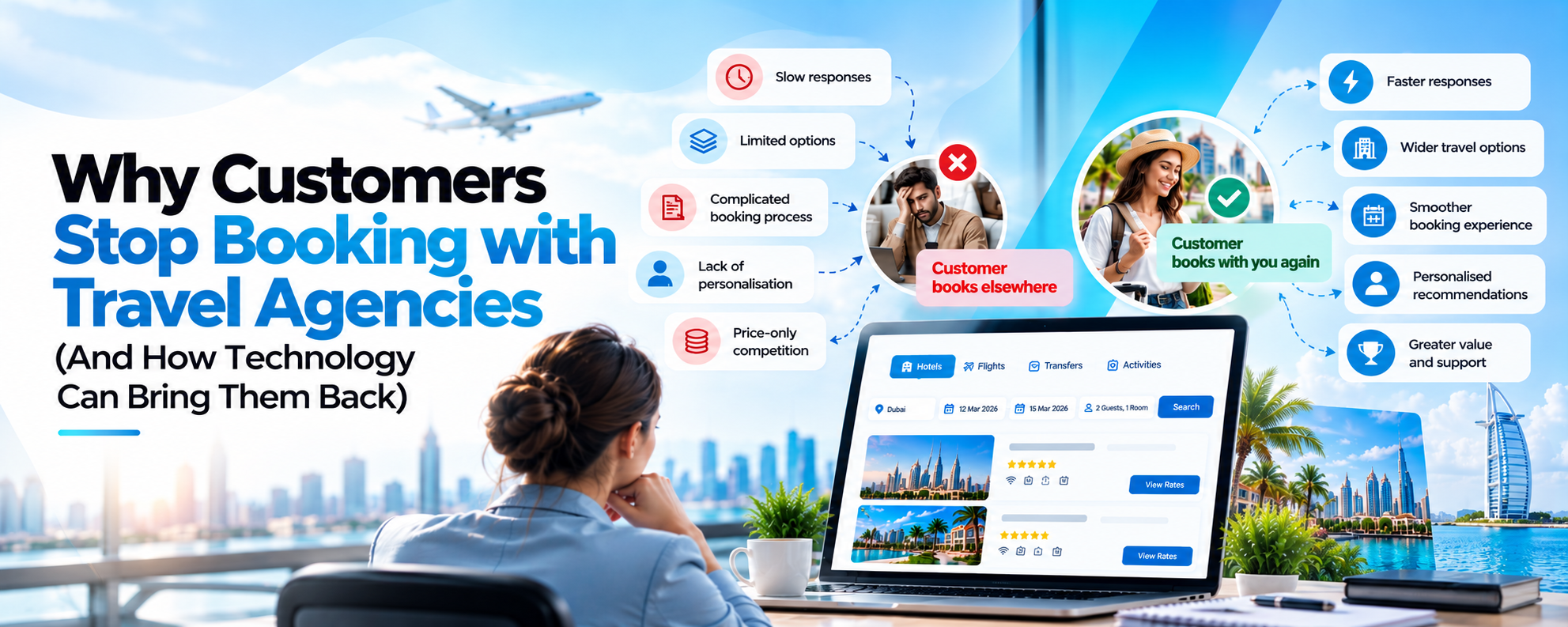
Why Customers Stop Booking With Travel Agencies
(And How Technology Can Bring Them Back)
Losing Customers Doesn't Always Mean Losing on Price
A customer enquires about a holiday. Your team searches for suitable hotels, compares available rates, checks flight options and prepares a quotation. Before the offer reaches the customer, they have already booked elsewhere.
Sound familiar?
For many travel agencies, losing customers is not always about offering the wrong destination or charging too much. Sometimes, it comes down to the time it takes to respond, the options presented, the ease of the booking process or the overall experience customers receive.
Today’s travellers have more ways than ever to research destinations, compare prices and make reservations. They may approach a traditional travel agency for expert advice and personalised service, but they also expect convenience, clear communication and timely responses.
This creates an important challenge for travel agency owners: how can you retain customers when travellers have more choices and higher expectations?
The answer is not necessarily to compete with every online booking platform on price. It is to combine the personal service of a travel professional with efficient processes and the right technology.
Let’s explore why customers stop booking with travel agencies, what agencies can do to rebuild those relationships and how travel technology can support long-term customer retention.
1. Slow Responses Can Cost You the Booking
When customers enquire about flights, hotels or holiday packages, they are often comparing multiple options. The agency that responds with relevant information at the right time has an opportunity to move the conversation forward.
A slow response can create uncertainty. Customers may wonder whether the agency has understood their requirements, whether suitable options are available or whether they should approach another provider.
Delays often happen because travel consultants must search multiple supplier websites, compare rates manually, verify availability and prepare quotations before they can respond.
While these steps may be necessary, an inefficient workflow can make the process unnecessarily time-consuming.
How agencies can improve response times
Standardise the information collected when an enquiry arrives.
Use a consistent process for searching, comparing and presenting options.
Keep customer requirements and follow-up actions organised.
Use booking technology that helps teams find relevant travel options more efficiently.
Follow up promptly when customers need additional information before making a decision.
The takeaway: Faster responses are not just an operational advantage. They help customers feel that their enquiry matters.
2. Limited Options Can Send Customers Elsewhere
Customers rarely have identical needs. One traveller may prioritise a luxury hotel in a central location, while another needs an affordable family stay. A business traveller may value convenience and flexibility more than a leisure traveller planning a longer holiday.
If an agency struggles to find suitable options quickly, customers may look elsewhere for a better match.
The challenge becomes greater when consultants need to search several suppliers separately to understand what is available.
How agencies can offer more relevant choices
Instead of presenting the first available option, travel consultants can improve the experience by:
Understanding the customer’s budget, preferences and priorities.
Comparing relevant accommodation or flight alternatives.
Explaining meaningful differences between options.
Offering suitable alternatives when the first choice is unavailable.
Confirming rates, availability and booking conditions before finalising an offer.
Access to a broader range of travel inventory can help agencies serve different customer requirements. A B2B travel booking platform can support this process by bringing travel options into a more convenient workflow.
The goal is not to overwhelm customers with dozens of choices. It is to present the right options with enough information to help them decide.
3. A Complicated Booking Experience Creates Friction
Even when an agency finds an attractive offer, the booking experience can influence whether a customer returns.
Repeated requests for the same information, unclear updates, inconsistent quotations and avoidable delays can make a straightforward reservation feel complicated.
Customers may tolerate some complexity when arranging a particularly specialised trip. However, repeated friction during ordinary bookings can weaken their confidence in the agency.
How agencies can create a smoother experience
Keep communication clear. Explain what is included, what remains to be confirmed and what the customer needs to do next.
Reduce repeated work. Organise enquiry details so that the team does not need to collect the same information repeatedly.
Set expectations. Tell customers when they can expect an update, especially when supplier confirmation is required.
Make the next step obvious. Present quotations in a format that makes it easy to understand the available options and proceed with a booking.
Maintain visibility. Keep the team informed about the status of enquiries, quotations and confirmed bookings.
A smooth experience does not require every interaction to be automated. It requires the process behind each interaction to work reliably.
4. Customers Want Personalised Advice, Not Just Prices
Digital booking tools make it easier for travellers to compare basic prices. This gives travel agencies an opportunity to differentiate themselves through knowledge, recommendations and service.
Customers may need help choosing the right hotel location, understanding different room options, coordinating flights or identifying alternatives that fit their budget. These are opportunities for a travel professional to demonstrate value.
However, personalisation becomes difficult when consultants spend most of their time on repetitive administrative tasks.
How technology can support a more personal service
Travel technology can help reduce the time spent searching and managing routine booking activities, allowing consultants to focus more attention on customer needs.
Agencies can strengthen this advantage by:
Recording customer preferences and previous requirements appropriately.
Tailoring recommendations to the purpose and budget of each trip.
Explaining why an option suits the customer’s needs.
Following up based on the customer’s decision stage.
Maintaining consistent service before, during and after the booking.
Technology should support the relationship, not replace it.
The strongest customer experience combines efficient digital processes with the judgement and personal attention of an experienced travel consultant.
5. Competing on Price Alone Can Undermine Loyalty
Price is an important factor in travel decisions, but it is not the only factor.
Customers also consider location, convenience, flexibility, reliability, support and the confidence they have in the person arranging their trip.
An agency that competes only by reducing its margin may find it difficult to build a sustainable business. There will almost always be another provider offering a different price.
Instead, agencies should make the value of their service visible.
How to demonstrate value beyond price
Present options that match the customer’s actual requirements.
Explain relevant differences in location, amenities, fare conditions or flexibility.
Be transparent about inclusions, exclusions and additional charges.
Help customers understand the trade-offs between available options.
Provide dependable support when plans change or questions arise.
Technology can help consultants compare and organise options, but it is the quality of the recommendation and the service around it that helps build trust.
The objective is to help customers make informed decisions—not simply to offer the lowest number on a quotation.
6. How Travel Technology Can Help Bring Customers Back
When customers leave, agencies often focus on the individual lost booking. However, recurring issues with slow quotations, limited visibility or complicated processes may affect many more enquiries.
Improving customer retention therefore requires a look at the workflow behind the service.
A suitable travel technology solution can help agencies make everyday operations more manageable, particularly when their teams work with multiple travel products and suppliers.
Centralise access to travel options
Searching across disconnected sources can add time to the quotation process. A B2B travel booking platform can provide a more convenient way for travel professionals to explore available products and options.
For agencies handling flights, hotels and other travel services, this can support a more organised approach to serving different customer requirements.
Make quotation workflows more efficient
When consultants can find and compare relevant options more conveniently, they may be able to prepare responses with less manual effort. The actual time saved depends on the agency’s workflow, supplier coverage and booking requirements.
Improve operational visibility
A more organised booking process can help teams understand what has been searched, quoted or booked, depending on the capabilities of the tools they use.
Better visibility can support follow-ups and help reduce the risk of enquiries being overlooked.
Give consultants more time for customer service
Reducing repetitive work can create more time for activities that need human judgement: understanding customer preferences, recommending alternatives and answering questions.
Support a broader range of customer needs
Access to multiple travel products through a B2B platform can help agencies explore different options for leisure, family and business travel, subject to the platform’s available inventory and applicable conditions.
Technology alone cannot guarantee repeat bookings. It can, however, help create the operational foundation for a more responsive and consistent customer experience.
7. How Travel Agencies Can Build Repeat Bookings
Winning back customers requires more than adopting a new tool. Agencies also need a repeatable approach to customer relationships.
Here are five practical steps to begin with.
Step 1: Review lost enquiries
Look at recent enquiries that did not convert. Where possible, identify whether the cause was price, response time, unsuitable options, availability, communication or another factor.
Avoid assuming that every lost enquiry has the same reason.
Step 2: Measure response and quotation times
Track how long it takes to acknowledge an enquiry, provide the first suitable options and follow up. Establish a baseline before introducing process changes.
Step 3: Improve the follow-up process
A customer may not book immediately because they are comparing options, waiting for approval or finalising travel dates. Use appropriate, timely follow-ups rather than relying on memory alone.
Step 4: Ask for feedback
When appropriate, ask customers what could have made the experience easier. Their feedback may reveal issues that internal teams do not notice.
Step 5: Review performance regularly
Monitor useful indicators such as:
Enquiry-to-booking conversion rate.
Average first-response time.
Average time to prepare a quotation.
Repeat booking rate.
Customer feedback and reasons for lost enquiries.
Review these indicators over time to identify patterns and evaluate whether operational changes are helping.
8. Choosing Travel Technology That Fits Your Agency
Not every agency needs the same technology. The right solution depends on the products sold, supplier relationships, team size, booking volume and existing processes.
Before selecting a B2B travel booking platform, consider the following questions:
Does it provide access to the travel products your customers regularly request?
Can your team search and compare relevant options conveniently?
Are rates, availability and booking conditions clearly presented?
Does the platform support the booking workflows your team needs?
Can your staff learn and use it effectively?
What support is available when the team needs assistance?
Does the solution fit your business requirements and operating budget?
Evaluate platforms against real scenarios from your agency rather than relying on feature lists alone. A demonstration using representative booking requirements can help your team understand whether a solution fits its day-to-day work.
How Travelclub Business Can Support Your Agency
Travelclub Business is a B2B travel platform designed for travel professionals, providing access to travel booking options across products such as flights, hotels and transfers.
For agencies looking to improve how they search for travel options and manage bookings, a platform like Travelclub can form part of a broader effort to make daily workflows more efficient.
Depending on the services and inventory available to your agency, Travelclub can help your team explore travel options through a dedicated B2B platform rather than treating every search as a completely separate task.
The objective is simple: support travel professionals with tools that help them serve their customers more effectively.
Register on the platform at business.travelclub.ae to learn more about its available features and booking options.
Better Customer Experiences Start Behind the Scenes
Customers do not always stop booking with travel agencies because they no longer need expert advice. They may leave because another provider offers a faster response, a more convenient process or options that better match their requirements.
For travel agencies, this creates a practical opportunity.
Review where enquiries are being lost. Make quotations easier to prepare. Improve communication. Offer relevant choices. Follow up consistently. And use technology where it can remove unnecessary work from the process.
Customer retention is not built through one feature or one successful booking. It grows through repeated experiences that make customers confident in choosing your agency again.
Ready to make your agency’s booking workflow more efficient?
Explore Travelclub Business and discover how a B2B travel platform could support your team’s everyday booking process.