
Blog
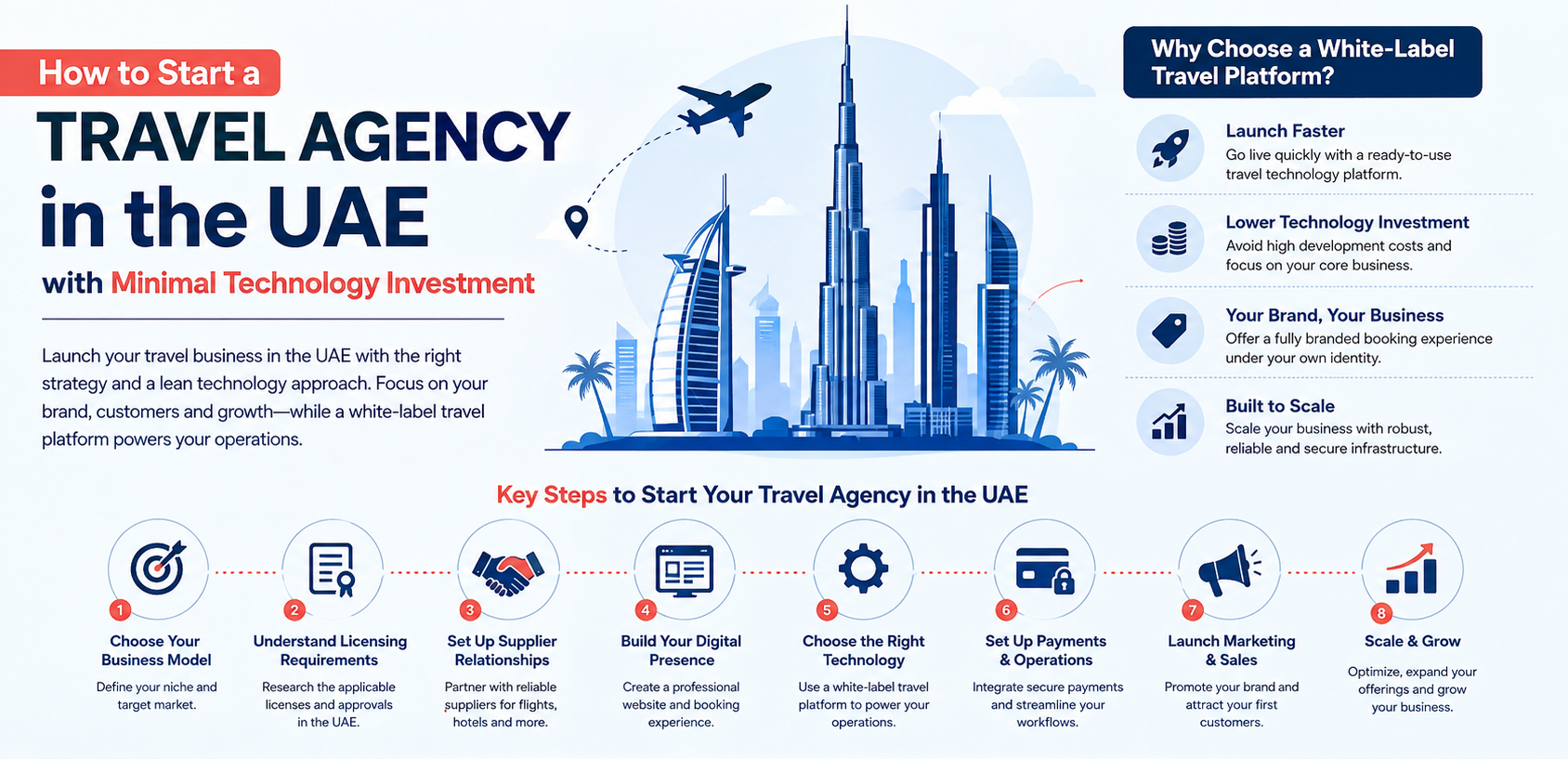
How to Start a Travel Agency in the UAE with Minimal Technology Investment
The UAE is one of the world’s most dynamic travel markets, making it an attractive destination for entrepreneurs looking to start a travel agency or launch a new online travel business.
But starting a travel agency today involves more than registering a business and selling holidays. Customers increasingly expect to search, compare, book and manage travel online. Building all the technology required to support that experience from scratch, however, can require significant time, technical expertise and investment.
The good news is that you don’t necessarily need to build your own travel technology.
With the right business model and a white-label travel technology solution, entrepreneurs can launch a branded travel business while reducing the need for expensive custom development.
In this guide, we’ll explain how to start a travel agency in the UAE, what you need to consider, where technology fits into your startup budget, and how white-label travel technology can help you launch with a leaner technology investment.
Why Start a Travel Agency in the UAE?
The UAE has established itself as a major global hub for tourism, business travel and international connectivity.
Dubai and Abu Dhabi attract leisure travellers, corporate visitors, families, luxury travellers and international businesses. At the same time, the UAE’s connectivity with destinations across Asia, Europe, the Middle East and Africa creates opportunities for agencies serving both inbound and outbound travel demand.
This creates opportunities for different types of travel businesses, including:
Leisure travel agencies
Corporate travel companies
Online travel agencies (OTAs)
Luxury travel businesses
Destination specialists
Group travel companies
Family holiday specialists
Business travel providers
Niche and specialist travel brands
However, the opportunity also comes with competition.
A new travel business needs to offer more than access to travel products. It needs a professional brand, convenient booking experiences, competitive inventory and efficient operations.
That makes technology an important part of the business model from the beginning.
The question is not whether a new agency needs technology.
The better question is:
How much technology do you actually need to build yourself?
What Does It Take to Start a Travel Agency in the UAE?
The exact requirements for establishing a travel business can vary depending on factors such as the emirate, jurisdiction, business activity and structure you choose.
Before launching, entrepreneurs should verify the applicable licensing and regulatory requirements with the relevant UAE authorities or a qualified local business advisor.
From a business-planning perspective, the process generally involves several key stages.
1. Choose your travel business model
Start by deciding what type of travel business you want to operate.
For example, you might focus on:
Flights and hotels
Holiday packages
Corporate travel
Luxury travel
Family holidays
Group travel
Destination-specific travel
A broader online travel marketplace
Your business model will influence your supplier relationships, technology requirements, target audience and marketing strategy.
2. Determine your business setup and licensing requirements
Your business structure, location and activities will determine which licenses and approvals may be applicable.
Don’t treat licensing as an afterthought. Make it one of the first areas you research before investing heavily in your website or technology.
3. Establish supplier and inventory relationships
A travel agency needs access to products it can actually sell.
Depending on your business model, this could include:
Flights
Hotels
Transfers
Activities
Packages
Other travel services
Technology can make managing this inventory considerably easier, particularly when multiple suppliers or distribution channels are involved.
4. Set up your customer-facing presence
Your website is often the first interaction a customer has with your business.
At a minimum, your digital presence should communicate:
Who you are
What you sell
Who you serve
Why customers should choose you
How customers can search or book
How customers can contact you
For an online-first agency, the website can also become the primary sales channel.
5. Set up your technology and operations
This is where many startups face a major decision.
Should you build your own booking system, connect multiple travel APIs, develop a customer portal and create your own back-office platform?
Or can you use an existing technology infrastructure?
For many new agencies, the second option can be considerably more practical.
How Much Does It Cost to Start a Travel Agency in the UAE?
There is no single startup cost that applies to every UAE travel agency.
Your investment can vary based on your business structure, licensing requirements, location, staffing, supplier arrangements, marketing strategy and technology choices.
Your main cost categories may include:
Cost area | What it can include |
Business setup | Registration, licensing and related fees |
Office and operations | Premises, equipment and operating expenses |
Employees | Sales, operations and customer support |
Supplier relationships | Commercial arrangements and supplier access |
Website | Domain, design, content and development |
Travel technology | Booking platform, integrations and infrastructure |
Payments | Payment processing and related services |
Marketing | SEO, advertising, partnerships and social media |
Customer support | Communication and service tools |
One of the areas where founders can make a strategic decision is technology.
A startup can spend a significant amount of money developing proprietary travel technology before it has even validated its business model.
That may not be necessary.
Instead, entrepreneurs can consider using established travel technology and putting more of their initial resources into customer acquisition, partnerships, sales and service.
What Technology Does a New Travel Agency Actually Need?
A modern travel agency needs technology that allows it to operate efficiently and give customers a convenient booking experience.
Depending on the business model, this can include:
A professional website
Travel search and booking functionality
Flight and/or hotel inventory
Booking management
Payment capabilities
Customer communication
Back-office tools
Supplier connectivity
Reporting and analytics
Customer support
Mobile-responsive interfaces
The important distinction is that needing technology doesn’t mean needing to develop technology from scratch.
A startup can use existing technology infrastructure to provide many of these capabilities.
This is where white-label travel technology becomes particularly relevant.
Should You Build Your Own Travel Booking Platform?
For a new travel business, building a complete travel platform from the ground up can be a major undertaking.
You may need to consider:
Front-end development
Back-end architecture
Travel APIs
Supplier integrations
Search functionality
Booking workflows
Payment integration
User accounts
Administration tools
Booking management
Testing
Security
Ongoing maintenance
Technical support
Even after the initial development is complete, the technology requires ongoing updates and maintenance.
For a technology company where the software itself is the primary competitive advantage, building proprietary infrastructure may make sense.
For a travel entrepreneur whose main advantage is their market, customer relationships, expertise or distribution, building everything internally may not be the best use of startup capital.
That’s why it is worth comparing three approaches.
Build vs. Buy vs. White-Label Travel Technology
Build from scratch
Building your own platform gives you a high level of control over the product.
However, it generally requires:
Developers
Product management
Technical architecture
API integrations
Testing
Maintenance
Ongoing development
It can also take considerably longer to bring the product to market.
Use separate third-party tools
Another approach is to combine different software products for different functions.
This may reduce development requirements, but it can create its own challenges.
You may end up managing multiple vendors, systems, integrations and user experiences.
Use a white-label travel platform
A white-label approach allows a travel business to use an existing technology infrastructure while presenting the customer-facing experience under its own brand.
Instead of developing every component yourself, you can build your travel business on top of established technology.
For many startups, this can mean a faster path to market and a lower need for custom software development.
Factor | Build from scratch | Third-party tools | White-label platform |
Development requirement | High | Medium | Lower |
Time to market | Longer | Medium | Typically faster |
Customisation | High | Varies | Depends on provider |
Technical management | High | Medium | Lower than custom development |
Initial technology burden | High | Medium | Potentially lower |
Best suited to | Technology-led businesses | Established businesses | Startups and agencies seeking faster launch |
White-label doesn’t mean there are no costs.
It means you’re using existing infrastructure rather than funding the development of an entire technology stack yourself.
What Is a White-Label Travel Platform?
A white-label travel platform is an existing travel technology solution that can be presented to customers under your own business brand.
Think of it this way:
Travel technology infrastructure → Your branding → Your customers
Instead of asking your development team to create a travel booking platform from zero, you can use an established solution as the technology foundation for your business.
Depending on the provider and solution, white-label travel technology can support areas such as:
Branded booking experiences
Travel search
Travel inventory
Booking workflows
Supplier connectivity
Booking management
Customer-facing functionality
Back-office operations
Other travel technology requirements
The exact capabilities vary between providers, so it is important to evaluate a platform based on your business model rather than choosing a solution based solely on price.
How to Start a Travel Agency with Minimal Technology Investment
If your goal is to launch a travel business without making a large upfront investment in custom technology, consider a lean approach.
Step 1: Start with a clear niche
Don’t try to serve every traveller from day one.
A focused proposition can make it easier to define your products, marketing and customer experience.
For example, you could focus on:
Corporate travellers
Luxury holidays
Family travel
Group tours
A specific destination
Business travel
Special-interest tourism
Your technology should support your business strategy—not the other way around.
Step 2: Avoid unnecessary custom development
Before commissioning a custom booking platform, identify which functionality already exists in the market.
Ask:
Is this technology genuinely a competitive advantage for my business, or am I simply rebuilding something that already exists?
This question can prevent significant unnecessary development costs.
Step 3: Use white-label travel technology
A white-label solution can provide the technological foundation required to launch a branded travel business without requiring you to develop every component yourself.
This can allow your team to focus on:
Customer acquisition
Sales
Partnerships
Branding
Service
Market positioning
Step 4: Invest in customer acquisition
Technology is only one part of the business.
Once your basic infrastructure is in place, your resources may be better directed toward generating demand through:
SEO
Paid search
Social media
Content marketing
B2B partnerships
Corporate relationships
Referral programmes
Email marketing
Step 5: Validate the business model
Don’t build a complex technology ecosystem before you know what your customers actually want.
Start with the capabilities you need to operate effectively, monitor customer behaviour and expand based on actual demand.
Step 6: Add proprietary technology when it makes business sense
A white-label platform doesn’t prevent you from developing proprietary technology later.
As your business grows, you may identify areas where custom technology can provide a meaningful competitive advantage.
At that point, you can make that investment based on real customer and business data.
What Should You Look for in a White-Label Travel Platform?
Not every white-label solution is the same.
Before choosing a provider, evaluate the platform against your business requirements.
1. Branding capabilities
Can the customer experience reflect your brand rather than the technology provider’s brand?
2. Travel inventory
Does the solution provide access to the products your target customers actually want?
3. Booking functionality
Can customers search, compare and book efficiently?
4. Integration capabilities
Can the platform connect with the suppliers, APIs and services required by your business?
5. Scalability
Can the technology support your business as transaction volumes and product requirements increase?
6. User experience
A technically capable platform can still perform poorly if the customer journey is complicated.
Look at:
Search
Filtering
Product information
Booking
Checkout
Confirmation
Post-booking management
7. Support
Find out what happens when something goes wrong.
Ask about:
Technical support
Integration support
Updates
Maintenance
Issue resolution
Account management
8. Commercial model
Understand the pricing structure before committing.
Ask about:
Setup fees
Subscription fees
Transaction fees
Integration costs
Customisation
Support
Additional modules
A lower headline price does not necessarily mean a lower total cost.
How Travelclub Can Help You Launch a Branded Travel Business
Starting a travel business shouldn’t require you to become a technology development company.
Travelclub’s white-label travel technology can provide a foundation for businesses that want to create a branded travel experience without developing their entire travel technology stack from scratch.
Instead of investing heavily in building core travel infrastructure, your business can focus on what differentiates it:
Your brand.
Your market.
Your customers.
Your sales strategy.
A white-label approach can be particularly relevant if you are:
Launching a new travel business
Expanding an existing travel agency into digital channels
Creating an online travel agency
Entering a new travel market
Looking for a branded booking experience
Reducing the need for custom technology development
The right solution depends on your products, target market, expected booking volume and business model.
Want to explore a white-label travel solution?
If you’re planning to launch or expand a travel business in the UAE, speak to Travelclub about your requirements.
Talk to a Travel Technology Expert
Tell us about your business model, target market and technology requirements, and explore how a white-label approach could support your launch.
Starting a travel agency in the UAE can be an attractive business opportunity, but founders need to think carefully about where they put their initial capital.
Building a complete travel technology platform from scratch can consume significant time and resources—resources that could otherwise be invested in acquiring customers, developing partnerships and growing the brand.
A leaner approach is to use established travel technology and, where appropriate, a white-label platform to provide the digital infrastructure behind your business.
The objective isn’t simply to spend less on technology.
It’s to invest in technology strategically.
Build what differentiates your business. Use established infrastructure where it makes sense. And put your resources into the things your customers actually value.
If you’re planning to start a travel agency or online travel business in the UAE, Travelclub can help you explore the technology options available for building a branded travel business.
Ready to explore your white-label travel business?
Talk to Travelclub today.