
2026
How the Fastest Travel Agencies Win More Customers Than the Cheapest Ones
Price gets attention. But speed can win the opportunity.
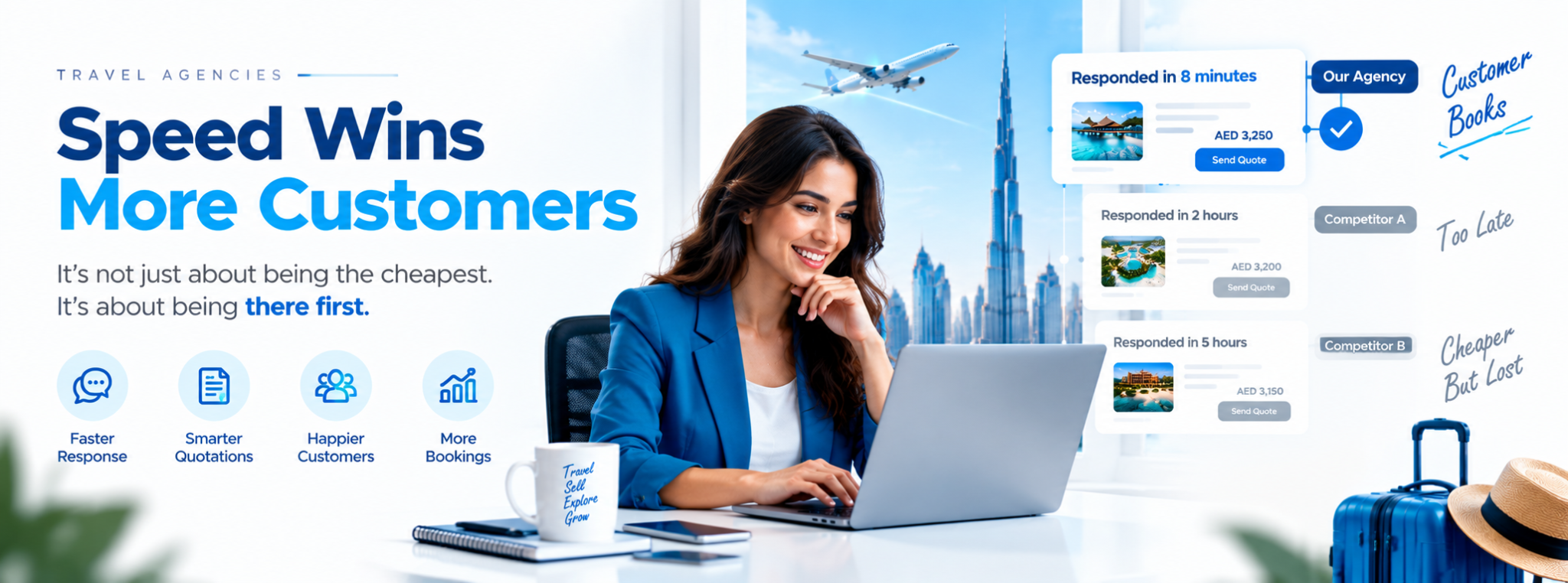
Imagine a customer sends the same holiday enquiry to three travel agencies.
All three agencies have access to similar flights and hotels.
Agency A responds quickly with three relevant options, a clear quotation and an easy path to booking.
Agency B takes several hours to prepare the quotation.
Agency C eventually sends the lowest price—but by then, the customer is already discussing the trip with Agency A.
Who gets the booking?
The answer isn’t always the agency with the lowest price.
In today’s travel market, price is only one part of the customer decision. Service quality, convenience, trust, availability and the overall booking experience also influence whether a customer continues with an agency.
Recent research illustrates this broader picture. In a Survey, 77% identified price/value as an important travel decision factor, while 51% cited customer-service quality and 48% cited booking convenience.
For travel agencies, this creates an important competitive question:
What happens when two agencies offer comparable products, but one can respond, quote and move the customer toward booking faster?
The answer starts with understanding that speed isn’t simply about replying quickly. It’s about reducing the time between customer enquiry and useful action.
The Cheapest Travel Agency Doesn't Automatically Win
Let’s be clear: price matters.
In fact, it remains one of the strongest factors in travel purchasing decisions.
Customers compare flight fares. They compare hotel rates. They look for promotions, inclusions and value.
But a travel purchase is rarely based on price alone.
Customers may also ask:
How quickly did the agency respond?
Did they understand what I actually wanted?
Did they provide relevant options?
Is the quotation easy to understand?
Are the inclusions and exclusions clear?
Can I trust the agency?
How easy is it to make changes?
How quickly can the booking be confirmed?
Will someone help me if something goes wrong?
In a survey found that customer service quality and booking convenience ranked behind price/value but remained significant factors in travel decisions. The same research found that nearly 70% of respondents said they would be likely to switch travel brands after a negative experience.
That creates an important distinction for travel agencies:
Being cheaper can help you compete on price.
Being faster and easier to deal with can help you compete on experience.
The strongest agencies don’t necessarily choose one or the other.
They work toward delivering competitive value without creating unnecessary friction.
Speed Is Becoming Part of the Customer Experience
When a customer contacts a travel agency, the clock starts.
Not necessarily because the customer expects an instant booking.
But because the customer has a decision to make.
They may already be:
Comparing agencies
Checking online prices
Speaking to another consultant
Looking at hotel options
Comparing dates
Waiting for approval from a family member or company
Trying to decide whether to book now or later
The agency that can provide a useful response sooner has an opportunity to shape that decision earlier.
And the importance of speed isn’t unique to travel agencies.
Google and Deloitte’s research into mobile website performance analyzed 7.4 million travel user sessions and found that travel conversion rates were particularly influenced by improvements in site speed. A 0.1-second improvement in one of the measured speed metrics was associated with a 10.1% increase in mobile conversion rate in the study.
That statistic should not be interpreted as saying that a travel consultant answering an enquiry 0.1 seconds faster will generate 10.1% more bookings.
It doesn’t measure that.
What it demonstrates is a broader principle:
Reducing friction in the travel buying journey can influence movement through the conversion funnel.
For an agency, the equivalent operational question is:
How much friction exists between receiving an enquiry and giving the customer a useful answer?
The Real Competition Happens Before the Booking
Many agencies think the competition begins when they send a price.
In reality, it can begin much earlier.
Consider the typical agency sales journey:
Customer Enquiry
↓
Requirement Understanding
↓
Flight / Hotel Search
↓
Option Comparison
↓
Quotation Preparation
↓
Customer Review
↓
Follow-up
↓
Booking
There are multiple points where momentum can be lost.
If searching takes too long, the customer waits.
If quotation preparation takes too long, the customer waits.
If the quotation isn’t clear, the customer asks more questions.
If the consultant has to repeat the entire process after a small change, more time is lost.
And while all this is happening, the customer can continue comparing alternatives.
The lesson for travel agencies is straightforward:
The booking isn’t only won at the payment screen. It can be won—or lost—during the journey leading to it.
Faster Doesn't Mean Rushed
There is an important difference between speed and hurry.
A fast agency shouldn’t send the first available option simply to respond quickly.
That can create new problems:
Wrong travel dates
Irrelevant hotels
Missing inclusions
Incorrect passenger details
Poorly explained fare conditions
Uncompetitive options
Additional clarification cycles
The goal isn’t:
“Send something quickly.”
The goal is:
“Deliver the right information faster.”
A useful travel-agency response should combine four things:
Speed
Get the customer an answer without unnecessary delays.
Relevance
Recommend options that actually match the requirement.
Accuracy
Make sure the information, pricing and conditions are correct at the time of quotation.
Clarity
Make it easy for the customer to understand and compare the options.
That combination is far more powerful than speed alone.
5 Ways Fast Travel Agencies Create More Booking Opportunities
1. They Reduce Manual Searching
One of the biggest sources of delay inside a travel agency is fragmented searching.
A consultant may need to move between different systems, supplier portals, hotel platforms and spreadsheets before having enough information to prepare a quotation.
Every additional step adds operational time.
A unified booking environment can reduce unnecessary switching and make it easier to search and compare travel products.
Modern B2B travel platforms increasingly bring flights, hotels and transfers into centralized workflows for precisely this reason. Travelclub, for example, provides access to flight inventory across GDS, LCC and NDC sources alongside global hotel and transfer inventory through one B2B platform.
The objective isn’t simply convenience.
It is reducing the amount of time consultants spend performing repetitive operational tasks.
2. They Create Quotations Faster
Quotation preparation is often where valuable selling time disappears.
The consultant may already have found the flight and hotel.
But then comes the administrative work:
Copying itinerary information
Adding hotel details
Formatting prices
Preparing inclusions
Adding markup
Creating a professional quotation
Making revisions
Sending the final version
If this process has to be repeated manually for every enquiry, the agency’s sales capacity becomes limited by administration.
This is where quotation automation can make a meaningful operational difference.
Travelclub’s Dynamic Quote Clipper, for example, is designed to help capture booking information and simplify quotation preparation, reducing repetitive manual work between searching and presenting an option to the customer.
The benefit isn’t simply saving a few minutes.
It can give consultants more time to do the part of the job that technology cannot replace:
understanding customers, recommending options, handling objections and closing business.
3. They Present Relevant Options—Not Endless Options
More choices don’t always create better decisions.
Imagine receiving a hotel quotation containing 25 properties.
The customer now has another problem:
Which one should I choose?
A better approach is to narrow the selection around the customer’s actual requirement.
For example:
Business traveller
Location near the office
Flexible cancellation
Reliable connectivity
Appropriate room category
Family holiday
Family rooms
Location
Breakfast
Pool / facilities
Overall value
Budget traveller
Competitive price
Convenient location
Essential facilities
The faster agency isn’t necessarily the one that sends the most options.
It is the one that can identify useful options and present them clearly.
This is where travel consultants still provide significant value.
Technology can accelerate the search.
The consultant adds the judgment.
4. They Follow Up While the Opportunity Is Still Active
Getting the quotation out is not the end of the sales process.
It is the beginning of another stage.
The customer may ask:
“Can you reduce the price?”
Or:
“Can you find something closer to the city centre?”
Or:
“What about another hotel?”
Or:
“Can you check an earlier flight?”
A consultant who has spent most of the day manually preparing the first quotation has less time to handle these conversations.
A faster workflow changes that equation.
Instead of spending most of the time preparing information, the consultant can spend more time selling the solution.
That distinction is important.
Slow workflow
Search → Prepare → Format → Send → Repeat
More efficient workflow
Search → Quote → Discuss → Adjust → Follow up → Book
The second workflow gives the consultant more opportunities to interact with the customer.
5. They Make the Final Booking Easier
Even after a customer has decided to buy, unnecessary friction can still delay or disrupt the booking.
Customers don’t want to repeat information unnecessarily.
They don’t want unclear pricing.
They don’t want to discover unexpected charges at the final stage.
They don’t want to wait unnecessarily for confirmation.
Fullstory’s 2026 research identified hidden or unexpected fees as the top booking frustration among surveyed consumers, cited by 61%, followed by delayed or unhelpful customer service at 37%.
This reinforces a simple principle:
Speed is valuable only when it is combined with transparency and reliability.
The goal isn’t to push customers through the booking process.
It is to make the process straightforward enough that customers can confidently complete it.
What Does a Slow Quotation Workflow Really Cost?
The obvious cost of a slow process is time.
But the less obvious cost is lost selling capacity.
Consider a consultant handling 20 enquiries.
If every enquiry requires extensive manual searching, copying, formatting and revising, a significant part of the working day can disappear into administration.
That time could otherwise be spent on:
New customer enquiries
Follow-ups
Upselling
Cross-selling
Corporate accounts
Repeat customers
Group bookings
Relationship building
This is why travel-agency technology shouldn’t be evaluated only by asking:
“How much does the software cost?”
A better question is:
“How much productive selling time can the technology give back to my team?”
The Difference Between Being Fast and Being Efficient
These two ideas are related—but they aren’t identical.
A fast agency
Responds quickly.
An efficient agency
Has a process that makes quick responses repeatable.
That distinction matters as an agency grows.
A small agency might have one exceptionally experienced consultant who knows where to search, how to prepare quotations and how to follow up.
But what happens when enquiry volume doubles?
What happens when that employee is unavailable?
What happens when three consultants need to handle 50 enquiries?
Growth exposes process weaknesses.
A scalable agency cannot depend entirely on individual speed.
It needs systems that make efficient work easier for the entire team.
Technology Can Turn Speed Into a System
This is where modern B2B travel technology becomes strategically important.
A travel platform can help centralize parts of the booking workflow:
Inventory → Search → Compare → Quote → Book → Manage
Instead of making the consultant coordinate multiple disconnected tools, a unified platform can bring more of the workflow together.
Travelclub’s current B2B platform combines flight, hotel and transfer booking capabilities, with access to GDS, LCC and NDC flight inventory and global hotel inventory. Its platform also includes features such as Dynamic Quote Clipper, agent markup, ClubWallet and white-label capabilities.
For agencies, the value is not simply having another booking portal.
It is about creating a more efficient operating layer around customer demand.
And speed matters at the infrastructure level too.
Google’s Travel Analytics documentation notes that Google Flights may not display a booking link for an itinerary for several reasons, including cases where an API does not return a result or the response is too slow.
That illustrates how speed has become part of modern travel distribution itself—not just a customer-service concern.
What This Means for UAE Travel Agencies
For travel agencies operating in Dubai, Abu Dhabi, Sharjah and across the UAE, competition isn’t limited to agencies in the same neighbourhood.
Customers can compare:
Local travel agencies
Online travel agencies
Direct airline websites
Hotel websites
Aggregators
Social-media-driven travel businesses
Other agencies recommended through WhatsApp or personal networks
That makes differentiation increasingly important.
And differentiation doesn’t always mean having the lowest price.
An agency can differentiate through:
Better service.
Faster response.
Better recommendations.
Broader inventory.
Clearer quotations.
More convenient booking.
Stronger relationships.
Better technology.
The opportunity is to combine these strengths rather than competing on a single dimension.
The Fastest Agency Isn't Always the Cheapest
This is the key idea behind the entire discussion.
The objective isn’t to become the agency that sends the fastest quotation regardless of quality.
And it isn’t to become the agency with the lowest price regardless of margin.
It is to build a travel-sales operation capable of doing both important things well:
Compete intelligently on value.
and
Respond efficiently to customer demand.
Because when customers are comparing multiple agencies, the first agency to provide a relevant, transparent and useful response has an opportunity to shape the conversation.
Price still matters.
But price isn’t the only conversation happening.
From Speed to Competitive Advantage
Think about two travel agencies.
Agency A
Searches across fragmented systems
Manually prepares quotations
Spends significant time formatting information
Responds after competitors
Has limited time for follow-ups
Agency B
Accesses inventory through a unified platform
Searches efficiently
Creates quotations faster
Presents relevant options
Spends more time communicating with customers
Follows up while the enquiry is active
Agency B doesn’t automatically win every booking.
But it has created a more efficient environment in which its team can respond, communicate and sell.
And that is the real competitive advantage.
Speed isn’t the strategy.
Speed is an outcome of a better process.
Where Travelclub Fits In
Travelclub is built around the operational needs of travel professionals, bringing flights, hotels, transfers and other travel tools together through a B2B travel platform. The platform provides access to GDS, LCC and NDC flight inventory, global hotel inventory and transfer services, alongside tools designed to simplify agency operations.
For agencies looking to reduce the gap between customer enquiry and booking, features such as Dynamic Quote Clipper can help simplify quotation preparation and reduce repetitive manual work.
The bigger idea is simple:
Give travel consultants better tools so they can spend less time processing bookings and more time winning them.
That doesn’t mean technology replaces the travel consultant.
It gives the consultant more room to do what matters most:
understand the customer, recommend the right solution, build trust and close the booking.
Don't Compete Only on Price
The travel industry will always be competitive on price.
Customers will continue to compare fares, hotel rates and packages.
But agencies don’t have to make “being the cheapest” their entire competitive strategy.
A stronger approach is to look at the complete customer journey.
How quickly do you respond?
How quickly can you search?
How quickly can you create a useful quotation?
How relevant are the options you provide?
How easy is it for customers to make a decision?
How much time does your team spend selling—and how much time do they spend doing administrative work?
The agencies that answer these questions well can create an experience that is valuable even when they aren’t the absolute cheapest option.
Because in travel sales, the lowest price can win a comparison.
But a faster, clearer and more useful experience can help win the conversation that leads to the booking.
Frequently Asked Questions
- Does the cheapest travel agency always get the booking?
-
No. Price/value is a major factor in travel decisions, but customer service and booking convenience also influence travelers. A 2026 Fullstory survey found price/value was cited by 77% of respondents, customer-service quality by 51%, and booking convenience by 48%.
- How quickly should a travel agency respond to an enquiry?
-
There isn't a single evidence-based response-time target that applies to every travel agency or enquiry. What matters is reducing unnecessary delay between receiving the enquiry and providing a useful, relevant response.
- How can travel agencies create quotations faster?
-
Agencies can reduce quotation time by centralizing inventory access, reducing repetitive data entry, standardizing quotation workflows and using tools that capture booking information automatically. Travelclub's Dynamic Quote Clipper is designed to simplify quotation preparation.
- Can travel technology improve travel agency conversion?
-
Technology can reduce friction in searching, quoting and booking, but technology alone does not guarantee higher conversion. Conversion depends on multiple factors including price/value, relevance, service quality, trust, availability and the overall customer experience.
- Should travel agencies focus on price or speed?
-
They should not treat them as mutually exclusive. Competitive pricing remains important, while faster and more convenient service can improve the customer's overall experience. The objective should be to combine competitive value with an efficient booking process.
- How can a B2B travel platform help travel agencies respond faster?
-
A B2B platform can centralize access to travel inventory and reduce the need to work across multiple disconnected systems. Depending on the platform, it can also simplify quotations, payments, markup management and booking workflows. Travelclub brings flights, hotels and transfers into one B2B environment and provides additional tools for agency operations.
Ready to Make Your Travel Agency Faster?
Your customers are already comparing options.
Give your team the technology to respond with the right options faster.
Explore Travelclub and discover a smarter way to search, quote and book.