10 Best B2B Travel Booking Platforms in Europe
Which One Should Your Agency Choose in 2026?
Your Customers Expect More. Does Your Booking Technology Keep Up?
A customer walks into your travel agency with a simple request.
They want to fly from London to Dubai, stay in a comfortable hotel near the city centre and arrange an airport transfer. They have a preferred travel date, a budget and a particular experience in mind.
For your customer, it is one holiday enquiry.
For your team, it could mean checking airline availability, comparing hotel suppliers, reviewing room conditions, searching for transfers, calculating the total cost and preparing a quotation.
And while your team is doing all this, another customer may be waiting for a response.
This is the everyday reality for many travel agencies.
Customers expect faster responses, more choices and a smoother booking experience. They want their preferred flight, a suitable hotel and reliable ground transportation without having to navigate several disconnected processes.
For travel agencies, meeting these expectations requires more than good customer service. It requires the right booking technology and access to reliable travel inventory.
That is where B2B travel booking platforms become important.

The right platform can help your agency discover travel options, compare availability, manage bookings and serve customers more efficiently. It can also create opportunities to expand your product offering and grow without unnecessarily increasing operational complexity.
But with so many providers available, how do you choose?
In this guide, we explore 10 B2B travel booking platforms relevant to agencies operating in or serving the European market, explain what makes each different and identify the factors you should consider before choosing one.
Our aim is not to declare one universal winner. It is to help you identify the platform that best fits your agency’s business model and growth plans.
10 Best B2B Travel Booking Platforms to Consider in 2026
The following providers represent different parts of the B2B travel distribution ecosystem. They are presented as options to evaluate, not as an independently tested ranking from first to tenth.
Each has a different product focus, distribution model and intended audience. Before making a decision, agencies should confirm current market availability, registration requirements, commercial terms and product coverage directly with the provider.
1. Hotelbeds – B2B Accommodation Distribution
Best suited for: Travel agencies, tour operators and travel distributors looking for hotel distribution partnerships.
Hotelbeds is an established B2B accommodation distribution provider. Its business is focused on connecting hotel suppliers with travel distributors, including travel agencies and tour operators.
For agencies whose business depends heavily on accommodation, a hotel-focused distribution partner can be an important part of the sourcing strategy.
What to evaluate:
Hotel inventory and destination coverage
Availability and rate conditions
Booking and cancellation processes
Distribution and connectivity options
Support and post-booking services
Hotelbeds is worth considering when hotel sourcing and accommodation distribution are central to your agency’s business model.
2. Travelclub – A Connected B2B Travel Booking Platform
Best suited for: Travel agencies and travel businesses looking for a connected booking environment for flights, hotels and transfers.
Travelclub is a B2B travel booking platform designed to support travel agencies, tour operators and other travel businesses.
Its platform brings together flight, hotel and transfer booking capabilities within one booking environment.
For agencies, this is important because customer enquiries rarely fit neatly into one product category.
A customer requesting an international flight may also need accommodation. A family booking a holiday may need airport transfers. A business traveller may require a hotel close to a meeting location and transportation between the airport and hotel.
Instead of approaching every product enquiry as an isolated transaction, agencies can work towards managing more of the customer’s journey through a connected platform.
Key areas to explore:
Flight booking: Access flight options through GDS, low-cost carrier and NDC-related distribution sources.
Hotel booking: Search accommodation options through connected hotel inventory and supplier integrations.
Transfer booking: Explore ground transportation options for airport pickups and destination transfers.
Connected booking experience: Manage different travel product requirements within one platform.
Hotel API connectivity: Explore integration opportunities for businesses that need hotel content through their own technology.
Travelclub’s positioning is particularly relevant to agencies looking for a practical booking environment that supports multiple travel products.
The platform is designed to help agencies respond to customer requirements, improve booking workflows and explore opportunities to grow their travel business.
Why consider Travelclub?
Because a customer does not think in terms of separate supplier systems. They think about the journey they want to complete.
Your agency should be equipped to support that journey.
3. WebBeds – Global B2B Travel Distribution
Best suited for: Travel distributors and agencies seeking accommodation and related travel distribution services.
WebBeds operates in the B2B travel distribution space, connecting accommodation providers with travel sellers through its distribution network.
Its associated FIT Ruums business, for example, describes access to hotel accommodation and transfers through a booking site or API connection.
For agencies, the important consideration is understanding which regional product and distribution services are available through the specific WebBeds business or market they intend to work with.
What to evaluate:
Hotel supply and destination coverage
Transfer and additional travel services
Booking portal and API availability
Regional support
Commercial and cancellation conditions
4. RateHawk – Multi-Product Booking for Travel Professionals
Best suited for: Travel agencies looking for accommodation alongside flights, transfers and other travel services.
RateHawk offers a booking platform for travel professionals with access to accommodation from multiple suppliers. Its UK-facing product information also describes airline tickets, transfers, car rentals and train bookings.
This makes it relevant for agencies that want to source several parts of a customer’s journey rather than focus exclusively on hotel reservations.
Imagine a customer travelling to Paris. Your agency may need to arrange the flight, select a hotel close to the customer’s preferred area and organise an airport transfer.
Having multiple travel product categories available through a booking environment can help simplify that process.
What to evaluate:
Hotel and supplier coverage
Flight and transfer availability
Net and gross pricing models
Booking management features
API integrations and support
5. TBO – Global Travel Distribution Platform
Best suited for: Travel agencies and tour operators looking for access to multiple travel product categories.
TBO is a global travel distribution platform connecting travel suppliers with travel buyers.
Its published platform information covers hotels, flights, holiday packages, car rentals, transfers and other ancillary services.
For agencies managing different customer requirements, this type of multi-product environment can be useful.
One customer may request a simple hotel reservation. Another may need an international flight, accommodation and ground transportation. A broader travel product ecosystem can support different types of enquiries.
What to evaluate:
Available travel product categories
Supplier coverage and booking conditions
Post-booking services
Payment and commercial arrangements
Customer support and account management
6. Expedia TAAP – Travel Agent Affiliate Programme
Best suited for: Travel agents and agencies seeking an agent-oriented platform for accommodation and other travel products.
Expedia’s Travel Agent Affiliate Programme (TAAP) provides travel agents with access to Expedia Group’s travel inventory through an agent-focused booking experience.
Expedia’s published travel agency information describes accommodation, flights, car hire, transport options and activities, together with booking and itinerary management capabilities.
For an agency that frequently handles accommodation enquiries, this can be a useful option to evaluate.
What to evaluate:
Agency eligibility and supported markets
Accommodation and other available inventory
Commission arrangements
Booking and itinerary management
Customer support and payment options
Check the programme’s current availability and terms for your country before applying.
7. Dida – B2B Travel Distribution and Technology
Best suited for: Travel agencies, online distributors and travel businesses looking for global inventory and connectivity.
Dida provides B2B travel distribution services and technology for travel sellers.
Its published product information describes hotel and flight inventory, transfers, car rental, activities and other travel products. It also offers an agent booking portal and API connectivity.
This makes Dida relevant for agencies evaluating both ready-to-use booking environments and technology connections for their own distribution channels.
What to evaluate:
Hotel inventory and direct contracting
Flight and transfer product availability
Agent portal functionality
API capabilities
Destination coverage and support
8. Amadeus – Travel Distribution and Agency Technology
Best suited for: Agencies requiring airline distribution technology and broader travel content access.
Amadeus is a major travel technology and distribution provider.
Its travel distribution ecosystem connects travel providers with travel sellers, including agencies, tour operators and online travel businesses.
For agencies with a strong air-booking business, GDS and airline distribution capabilities are important considerations.
Amadeus also offers hotel content and other travel-related capabilities through its travel seller solutions.
What to evaluate:
Airline content and distribution
GDS and NDC capabilities
Hotel content availability
Front-office and agency tools
API and integration requirements
An agency should assess the technology, implementation requirements and commercial model against its own booking volumes and business needs.
9. Sabre – Travel Retailing and Distribution Technology
Best suited for: Travel businesses that need sophisticated travel distribution, airline content and booking technology.
Sabre provides technology and distribution solutions for travel suppliers and sellers.
Its SabreMosaic ecosystem is designed to bring together different travel content sources and support shopping, booking and servicing workflows.
For agencies dealing with complex flight requirements, multiple airline options and broader travel content, these capabilities are worth exploring.
What to evaluate:
Airline content and distribution
Hotel and other travel content
NDC and low-cost carrier capabilities
Booking and servicing workflows
Technology and integration requirements
Sabre may be particularly relevant for agencies with more advanced distribution or technology requirements.
10. Travelport – Multi-Source Travel Content
Best suited for: Agencies that want to bring multiple travel content sources into their booking workflows.
Travelport’s Travelport+ platform brings together traditional air content, NDC, low-cost carriers, hotels, car rentals and rail content.
Its approach focuses on multi-source content and tools designed to support the search, comparison, booking and servicing of travel products.
For agencies, this can be valuable when customers expect more options and agents need to compare travel content from different sources.
What to evaluate:
Air content and airline connections
NDC and low-cost carrier access
Hotel, car and rail content
Search and comparison experience
Agency tools and integrations
What Should Your Agency Compare Before Choosing a B2B Platform?
A platform may have an impressive product catalogue, but that does not automatically make it the right solution for your agency.
The real question is whether it helps your team serve customers better and operate more efficiently.
Here are seven factors worth evaluating.
1. Travel Inventory and Supplier Coverage
Inventory is one of the most important factors.
Can your team find suitable flights, hotels and transfers for the destinations your customers request?
Consider a customer travelling from London to Dubai.
Your team may need to compare airline options, find a hotel near Downtown Dubai and arrange a suitable airport transfer.
The platform should provide access to the product categories your agency actually sells, with clear availability, pricing and booking conditions.
2. Booking Experience and Speed
Your team’s time matters.
If agents spend too long searching through multiple systems, preparing quotations and checking availability, they have less time to focus on customer relationships.
Look for intuitive search, useful filters, clear product information and a booking process that does not create unnecessary steps.
3. Pricing and Margin Flexibility
Competitive rates matter, but the lowest displayed price is not the whole story.
Consider:
Net and gross pricing arrangements
Commission structures
Markup flexibility
Payment charges
Currency conversion
Cancellation and amendment costs
The goal is to understand the actual commercial value of using a platform, not just compare headline prices.
4. Booking Management and Post-Booking Support
A booking is not always the end of the customer journey.
Flight schedules can change. Customers may request a different hotel room. Transfer timings may need to be updated.
Your agency needs to understand how each platform handles amendments, cancellations, refunds and customer support.
A smooth booking experience is valuable. Reliable post-booking service is equally important.
5. API and Technology Integration
If your agency is planning to develop its own website, mobile application or online booking channel, API connectivity may be important.
A travel API can allow your business to connect inventory and booking functions to its own digital environment.
However, integration requirements differ. Check documentation, available endpoints, implementation effort, technical support and commercial terms.
6. Team Access and Reporting
As an agency grows, booking operations become more complex.
You may have multiple agents, branches, departments or sub-agents.
Consider whether the platform supports:
Multiple users and role-based access
Booking history
Reporting and sales visibility
Administrative controls
Branch or sub-agent management
These capabilities can help owners understand what is happening across the business.
7. Scalability and Long-Term Value
Do not select a platform only for the bookings you make today.
Think about the agency you want to operate in the next two or three years.
Will you expand your hotel business? Introduce flight bookings? Offer airport transfers? Build your own online booking channel?
Choose technology that can support your intended direction without introducing unnecessary complexity.
Why Flight, Hotel and Transfer Booking Should Work Together
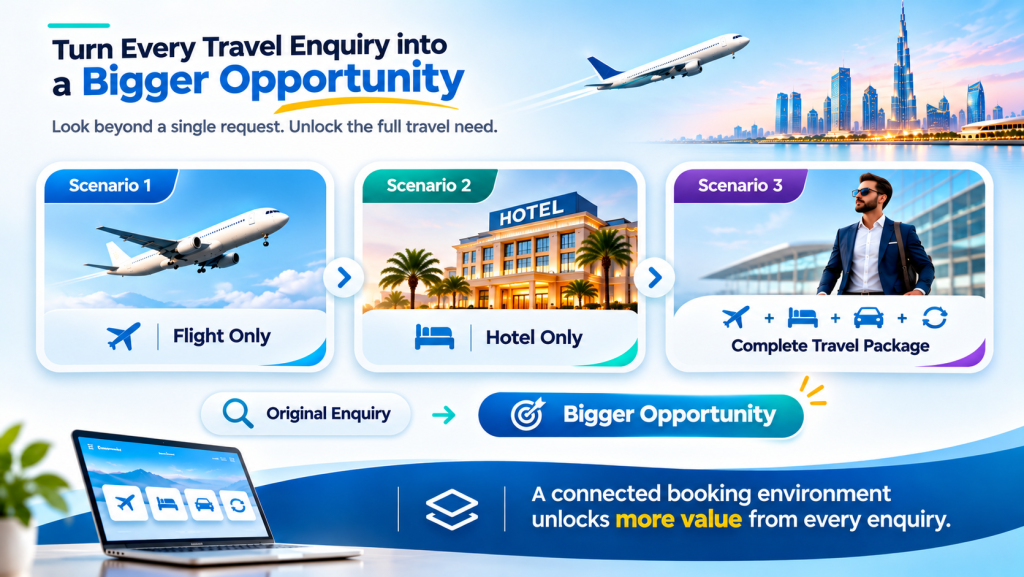
One of the biggest opportunities for a travel agency is to stop looking at every customer enquiry as a single-product sale.
Consider three everyday situations.
Scenario 1: The customer only asks for a flight
A customer requests a return flight from London to Dubai.
Your agency finds a suitable option and completes the booking.
But the customer’s travel requirement may not end there.
They may still need accommodation, airport pickup and transportation during their stay.
A proactive agent can ask the right questions and identify additional requirements.
Opportunity: Build a more complete travel solution around the original enquiry.
Scenario 2: The customer needs a hotel
A family is planning a holiday in Paris.
They already have their flights, but they need a hotel that fits their budget, preferred location and room requirements.
After helping them choose suitable accommodation, your agency can also explore airport transfers.
Opportunity: Make the customer’s arrival and stay easier while increasing the value of the service your agency provides.
Scenario 3: The customer wants a complete travel package
A corporate customer is travelling to Germany for a business meeting.
They need:
An international flight
A hotel near the meeting venue
An airport-to-hotel transfer
A return journey
Rather than treating these as disconnected requests, the agency can manage them as parts of one travel requirement.
Opportunity: Deliver a more convenient experience and create a stronger relationship with the customer.
The lesson is simple:
Every travel enquiry can be an opportunity to understand the customer’s complete requirement.
A connected booking environment can help your team explore these opportunities more efficiently.
Common Mistakes Travel Agencies Make When Choosing a Booking Platform
Even experienced agencies can make technology decisions that create problems later.
Choosing only based on price
A competitive rate is useful, but the full value of a platform includes usability, inventory, support, servicing and payment conditions.
Ignoring the actual booking workflow
A platform may look impressive during a presentation. But can your agents use it comfortably during a busy working day?
Test the complete journey: search, compare, book, retrieve and manage a reservation.
Overlooking post-booking services
Changes and cancellations are part of travel operations. Understand how these are handled before committing.
Selecting a platform that only solves today’s problem
A hotel-only solution may be appropriate for a hotel-focused agency. But a business planning to offer flights, hotels and transfers should evaluate whether its technology strategy can support that direction.
Not considering the customer experience
Technology should help agents serve customers better.
If it creates confusion, delays or unnecessary manual work, the platform may not be delivering the operational value your agency needs.
The Future of B2B Travel Booking: What Agencies Should Prepare For
The travel industry continues to evolve.
Customers increasingly expect convenient digital experiences, while travel agencies need technology that helps them manage more complex requirements.
Several developments are shaping the direction of B2B travel booking.
1. AI-Assisted Travel Discovery
AI can help agents research destinations, compare options and prepare recommendations.
However, a useful travel recommendation must connect to accurate, available and bookable inventory. AI-generated inspiration alone cannot complete a reservation.
2. More Connected Travel Inventory
Agencies are increasingly evaluating ways to access different travel content sources through connected platforms and APIs.
The objective is to reduce fragmented workflows and make relevant options easier to discover.
3. Better Search and Booking Experiences
Search technology, filters, predictive suggestions and improved user interfaces can help agents find suitable options with less effort.
4. More Flexible Travel Packages
Customers often want combinations of products rather than isolated reservations.
Technology that helps agencies bring flights, hotels and transfers together can support more complete travel solutions.
5. Better Use of Booking Data
Booking history and reporting can help agency owners understand sales patterns, identify customer preferences and make more informed business decisions.
The future will not be defined by technology alone.
It will be defined by how effectively agencies use technology to deliver better service.
Which B2B Travel Booking Platform Should Your Agency Choose?
There is no single platform that is ideal for every travel agency.
The right choice depends on your business model, customer requirements, product focus and future plans.
A hotel-focused agency may prioritise accommodation distribution. An air-focused agency may need strong GDS capabilities. A growing multi-product agency may prefer a platform that supports flights, hotels and transfers within a connected booking environment.
Before making a decision, ask yourself:
Does this platform provide the inventory my customers need?
Can my team search and book efficiently?
Can I manage the complete booking lifecycle?
Does the commercial model support my business?
Can the platform support my future growth?
Ultimately, the best technology is not necessarily the one with the longest feature list.
It is the one that helps your agency serve customers confidently, manage its operations efficiently and identify more opportunities to grow.
Give Your Travel Agency a Smarter Way to Book
Your customers are not just looking for a flight, a hotel or an airport transfer.
They are looking for a journey that feels easy from the moment they make an enquiry until they reach their destination.
Your agency deserves technology that helps you deliver that experience.
Travelclub brings flight, hotel and transfer booking capabilities together in a B2B travel booking environment designed for travel professionals.
Explore global travel inventory, discover booking opportunities and see how connected travel technology can support your agency’s next stage of growth.
One Global Connect. Book a FREE Demo –>